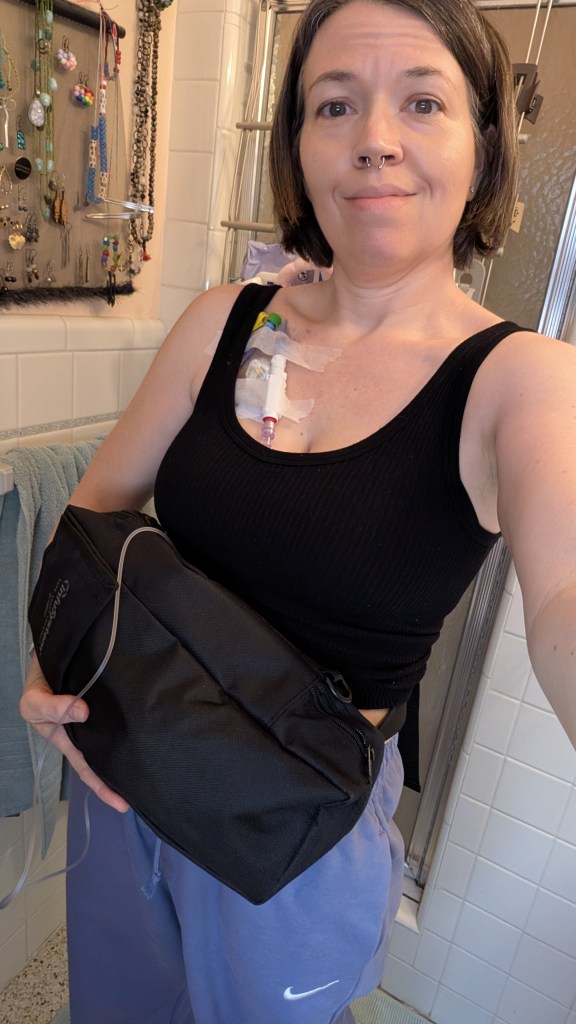
I’ve been feeling extra anxious lately, just thinking about the possibility of recurrence and what my future holds. I have one more round chemo. It’s an odd feeling. For the past nine months or so, my life has been consumed by cancer. My initial diagnosis, getting ready for surgery, recovering from surgery, going through chemo. At each step there were things to figure out, tasks to accomplish, or planning that needed to be done. All of this doing is about to come to a screeching halt. I’ve been climbing this mountain and suddenly I am alone peering over a cliff into the unknown.
I know I have some time left to go, but somehow it doesn’t feel like it’s over. Is this my body telling me that the cancer is going to come back? Is it my brain not knowing quite how to adjust to such a rollercoaster of a year? I would like to think it is the latter, and it probably is, that would make complete sense. But I guess my point is that this may just be how I feel for a while. Recurrence is most likely in the first two years after treatment. Maybe after that point I will be able to breathe a little easier?
I don’t think there are really any answers to these questions. I am someone who likes predictability, routine, planning. Yes, I like to be in control. Cancer has taught me that I am not in control. I am trying to learn this lesson, and in some spiritual ways I think I have adjusted my mindset. But I still am functioning in a world that expects you to go, go, go to survive. I have my kids and myself to take care of and I’ve always taken comfort in my ability to plan and set up my life so that everything works out okay. This has been a huge wake up call to the fact that I am not in control of anything. It’s both freeing and terrifying. I think the only thing to do is to live for today, to create as much joy in this life as we can, because tomorrow is not guaranteed, to me or to anyone.
After my pathology report came back, my next step was to make an appointment with an oncologist to find out what my treatment plan would be. I had a specific doctor in mind, so it was about three weeks before I could get an appointment. This was a long wait, but I tried to keep myself calm and spent the time writing down all of the many questions that were floating around in my head. I had also gone back to work by this point, so I was trying to focus on that and getting back to some sense of normalcy, even though life at that point was far from normal.
The doctor walked into the room, sat down, and the first thing he said to me was “stage 3, wow, what a shock, huh?” Finally, someone acknowledged what had been going through my mind since the pathology report came back! He went over the protocol for my stage of cancer. Due to the high risk of recurrence, six months of chemo was recommended. I had a choice between two protocols. One option was the Capox regimen, which would be a combination of an oxaliplatin infusion every three weeks along with oral chemo pills for 14 days, then seven days “off.” The other option was Folfox, which would be an oxaliplatin infusion every two weeks, with each infusion followed by two days with the 5-FU pump. He explained that because the Capox regimen only has the oxaliplatin every three weeks, the dose is higher and there is therefore higher toxicity associated with Capox vs. Folfox. Although the pump sounded like a pain (which it is), I opted for Folfox because I wanted to minimize the toxicity of my treatment. Since I was going to have the pump, a chemo port would be required, so I was scheduled for the port placement procedure the following week.
I was also offered an opportunity to participate in the Circulate – North America clinical trial. This trial is looking at whether circulating tumor DNA (ctDNA) should be used to guide treatment decisions for colorectal cancer patients who have undergone resection of their tumor (obviously I am not a medical professional, I am simply restating my understanding of the study, so take it with a grain of salt). The trial first involves a blood test for ctDNA. For this test, a sample of tumor tissue is analyzed to identify the primary mutations in the tumor. Then a blood sample is analyzed to see if those mutations are currently present, indicating that cancer cells are still being shed into the bloodstream. In the trial, if the ctDNA test is negative, then the patient is randomized into either a monitoring group that does not receive chemo, or a group receiving the traditional chemo treatment (either Folfox or Capox). If the ctDNA test is positive, then the patient is randomized to receive either a traditional chemo regimen or a more aggressive form of chemo (Folfirinox). If at a later point someone in the negative group had a positive ctDNA test, they would then be randomized to one of the treatment groups.
After talking this option over with my doctor, I decided to enroll in the study. I would be receiving the ctDNA test anyway, and I could always withdraw at any time if I decided I no longer wanted to participate. I had strong reservations about not undergoing chemo since I had such a large number of lymph nodes involved, but I decided to enroll in the study and see what happened.
I was allowed to have one cycle of chemo while I waited for my results. My first chemo infusion was on March 9. About two weeks later, I got a call from the clinical trial coordinator telling me that my ctDNA results came back. My test was negative! This was good news. However, I also learned that I had been assigned to the “monitoring” group that would not receive chemo. This left me with a big decision to make. I told the coordinator I would sleep on it and give her an answer the next day. It didn’t take me long to make a decision. My doctor told me that my chance of recurrence would be 25-30 percent even with chemo. I needed to know that I did everything possible to kill my cancer for good, and taking a “wait and see” approach just did not feel right. I called first thing the next morning to tell the coordinator that I was withdrawing from the trial. At that point, my next two chemo infusions were scheduled, and I was relieved to finally feel like we had a solid plan after so many months of uncertainty.
I’ve thought about writing since I was first diagnosed, almost 8 months ago. I’ve never been much for journaling, but there are so many thoughts constantly going through my head during this whole process that it seems healthy to get them down on paper. By sharing them, I hope that maybe I can help someone else who is on a similar journey. Or maybe a completely different journey. Who knows.
I say this story is starting in the middle, but the reality is that I actually don’t even know if I’m in the middle yet. There are so many unknowns with cancer, and while right now my focus is getting through chemo, the possibility of recurrence is something I will be dealing with for the rest of my life. The only thing I know for sure is I’m somewhere past the beginning. I am 5 months post-op after colon resection surgery and a little more than halfway through a 6-month chemo regimen.
I’ve never been spectacular at identifying my feelings. I remember when I started seeing a therapist more than a decade ago, and she actually had to give me a list of emotions to help me out. Cancer has brought up so many feelings. Fear, shock, sadness, optimism. That last one might sound strange, but in a way this whole process has been empowering. I feel like if I can endure this, I can endure anything (note to the universe: please don’t take that as a challenge). At any rate, I’ve decided to share my thoughts here because I think it will help me process this complete mind fuck of an experience, and maybe it will help someone else along the way.
I plan to write about my experience being diagnosed with cancer, going through treatment, and whatever else the future holds, cancer-wise. Anyone who knows me also knows that running has been a big part of my life for the past decade or so (with some breaks here and there). RunDisney in particular has been a huge source of joy and motivation in my life for the past couple of years, and it’s something I hope to get back to soon. While I took a bit of a break from running after I was diagnosed, I now have several races on the calendar so I’m starting to slowly get back into training. It feels good to have something to focus on other than cancer, even if running is physically harder than it has ever been. So this will also be a blog about running, to some degree. We shall see where my brain takes us.
On Monday morning I will head to Moffitt for infusion number eight. I have a total of twelve planned infusions. Each chemo cycle is two weeks. My infusions so far have been on Mondays. I show up, and the first step is labs so they can monitor how my body is handling chemo. They access my port (more about that later I guess, but it’s basically a little device implanted in my chest connected to a catheter that goes straight into my bloodstream near my heart). They take whatever blood they need, and the same port access is used to deliver my chemo. I see my doctor or PA before every other infusion, but I did that last time, so no provider visit this time.
Next, I go to the infusion center and wait to be called. My infusion takes about two and a half hours. First they give me pre-meds to ward off nausea and allergic reactions to the chemo, then it’s a 30 minute wait in a benadryl-induced stupor before the actual infusion starts. I’ll go into more detail on my actual chemo regimen in a later post, but I get one drug that takes ninety minutes, then a quick push of a second drug.
The second drug also goes into a pump, which is connected to my port access and I then have to haul around for about 48 hours.
This is not fun. When the pump was first described to me, I was told it was small and could fit under a loose t-shirt without being noticed. This is absolutely not true. It is large and heavy and a pain in the ass. Not to mention the constant worry about my cats chewing through the tubing and the absolute toxic chaos that would be unleashed. So far they’ve been good boys and have not bothered the poison tube.
That’s a chemo infusion in a nutshell. I’ll report back on how it goes. The first few days after my infusion are rough. By Friday (four days post-infusion) I usually start to get back to something resembling normal.
I haven’t written anything for others to read aside from memos for work (so many memos) in a very long time, so this will be an interesting exercise. Please let me know what you think! Are there any questions you have that you’d like me to answer?