• The Plan

    After my pathology report came back, my next step was to make an appointment with an oncologist to find out what my treatment plan would be. I had a specific doctor in mind, so it was about three weeks before I could get an appointment. This was a long wait, but I tried to keep myself calm and spent the time writing down all of the many questions that were floating around in my head. I had also gone back to work by this point, so I was trying to focus on that and getting back to some sense of normalcy, even though life at that point was far from normal.

    The doctor walked into the room, sat down, and the first thing he said to me was “stage 3, wow, what a shock, huh?” Finally, someone acknowledged what had been going through my mind since the pathology report came back! He went over the protocol for my stage of cancer. Due to the high risk of recurrence, six months of chemo was recommended. I had a choice between two protocols. One option was the Capox regimen, which would be a combination of an oxaliplatin infusion every three weeks along with oral chemo pills for 14 days, then seven days “off.” The other option was Folfox, which would be an oxaliplatin infusion every two weeks, with each infusion followed by two days with the 5-FU pump. He explained that because the Capox regimen only has the oxaliplatin every three weeks, the dose is higher and there is therefore higher toxicity associated with Capox vs. Folfox. Although the pump sounded like a pain (which it is), I opted for Folfox because I wanted to minimize the toxicity of my treatment. Since I was going to have the pump, a chemo port would be required, so I was scheduled for the port placement procedure the following week.

    I was also offered an opportunity to participate in the Circulate – North America clinical trial. This trial is looking at whether circulating tumor DNA (ctDNA) should be used to guide treatment decisions for colorectal cancer patients who have undergone resection of their tumor (obviously I am not a medical professional, I am simply restating my understanding of the study, so take it with a grain of salt). The trial first involves a blood test for ctDNA. For this test, a sample of tumor tissue is analyzed to identify the primary mutations in the tumor. Then a blood sample is analyzed to see if those mutations are currently present, indicating that cancer cells are still being shed into the bloodstream. In the trial, if the ctDNA test is negative, then the patient is randomized into either a monitoring group that does not receive chemo, or a group receiving the traditional chemo treatment (either Folfox or Capox). If the ctDNA test is positive, then the patient is randomized to receive either a traditional chemo regimen or a more aggressive form of chemo (Folfirinox). If at a later point someone in the negative group had a positive ctDNA test, they would then be randomized to one of the treatment groups.

    After talking this option over with my doctor, I decided to enroll in the study. I would be receiving the ctDNA test anyway, and I could always withdraw at any time if I decided I no longer wanted to participate. I had strong reservations about not undergoing chemo since I had such a large number of lymph nodes involved, but I decided to enroll in the study and see what happened. 

    I was allowed to have one cycle of chemo while I waited for my results. My first chemo infusion was on March 9. About two weeks later, I got a call from the clinical trial coordinator telling me that my ctDNA results came back. My test was negative! This was good news. However, I also learned that I had been assigned to the “monitoring” group that would not receive chemo. This left me with a big decision to make. I told the coordinator I would sleep on it and give her an answer the next day. It didn’t take me long to make a decision. My doctor told me that my chance of recurrence would be 25-30 percent even with chemo. I needed to know that I did everything possible to kill my cancer for good, and taking a “wait and see” approach just did not feel right. I called first thing the next morning to tell the coordinator that I was withdrawing from the trial. At that point, my next two chemo infusions were scheduled, and I was relieved to finally feel like we had a solid plan after so many months of uncertainty.

  • The Verdict

    After my MRI and CT, my case went before Moffitt’s tumor board and I was recommended for surgery. I had another appointment with the surgeon to go over the details of my surgery and what to expect. One of my main questions was whether I would end up with an ostomy bag after surgery. Based on the location of my tumor, the doctor said there was about a 25% chance I would need an ostomy, and if I did, it most likely would be temporary. Obviously my main concern was getting rid of the cancer and just surviving, but I was relieved that the chances of needing a bag were low. If I needed one, then so be it. 

    The doctor explained that my surgery would be a laparoscopic, robotic-assisted procedure, which would be converted to an open surgery if for some reason they could not do what needed to be done laparoscopically. The surgery would take about four to five hours. They would remove the lower part of my colon and upper part of my rectum (my tumor was right at the rectosigmoid junction, where the sigmoid colon and rectum meet), and would take a portion on either side in hopes of getting clear margins, meaning healthy, non-cancerous tissue on either side. She would also remove all of the lymph nodes in that region. I could expect to be in the hospital for two to five days following surgery. She recommended eight weeks off work for recovery. 

    Surgery was scheduled for January 14, 2026. My surgery was scheduled for 7am, so my mom and I arrived somewhere around 5am. We walked into Moffitt and were greeted by someone with a clipboard, who checked my name off their list and told us to have a seat and someone would call us. This is pretty unusual, if you’ve ever had surgery or a procedure, usually you have to find the registration desk, wait in some kind of line, and then do all your paperwork. The experience at Moffitt felt very bespoke. We were soon called to go over a few details, and then were taken back to the pre-op area. I changed into a gown that hooked up to a warm air blower, which would keep my body temp up during surgery in the cold OR. The surgeon came in to say a quick hello, and pretty soon after that they gave me the good drugs and the rest is just a blur.

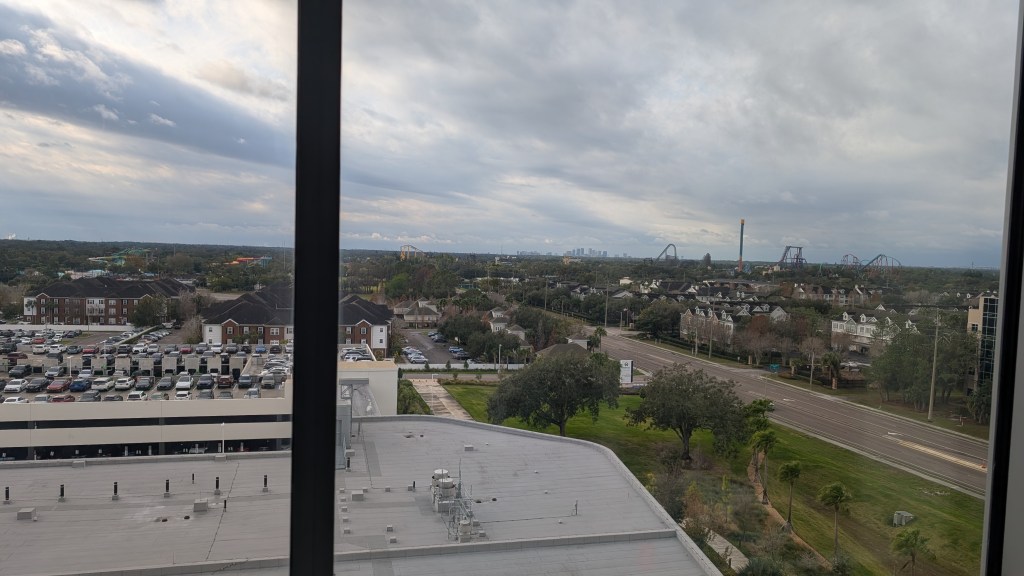
    I remember waking up in recovery multiple times with alarms beeping because I kept falling asleep and forgetting to breathe. They gave me a lot of morphine. Eventually I woke up enough for them to wheel me out of recovery and to my actual hospital room. We had a view of Busch Gardens (in the distance)!

    I spent three nights in the hospital, surgery was on Wednesday and I went home Saturday morning. The worst pain was from my incision sites and the gas they use during laparoscopic surgery to be able to see everything. I would say the recovery was very uncomfortable but overall not terribly painful. Moffitt really wants patients up and walking as soon as possible after surgery, so the PT team was in my room first thing on the morning after my surgery to get me moving. I made a few laps that day, but walking was painful and exhausting. Friday was better, I was upgraded from yellow to brown socks, meaning I could walk around on my own, and I was able to walk the halls quite a bit. On Saturday I was given the okay to go home, and I couldn’t wait to get home to my own couch and bed.

    Now, the long wait for my pathology results. The pathology report was really important because if the cancer had not spread to my lymph nodes and had not gone through my colon wall, then I wouldn’t need chemo and my treatment would be over after surgery. If the cancer had spread beyond my colon, I would likely need chemo. My surgeon said pathology usually comes back 7-10 days after surgery, but mine took more than two weeks. I spent so much time in the portal refreshing my results. 

    Eventually, the report showed up. I held my breath and opened it, quickly scanning for the bottom line. There it was: “Metastatic adenocarcinoma in thirteen of twenty-five lymph nodes.” I felt numb. This is not the news I was expecting. I had geared myself up mentally for this roller coaster to quickly jolt me to a stop after surgery. And it wasn’t just a little worse than we thought, it was A LOT worse. Spread to thirteen lymph nodes is significant. My cancer officially was staged as T3N2b, or stage 3c. 

    My pathology report showed up in the portal at night, but my doctor called me first thing the next morning. She explained that because of the staging, treatment would now involve chemo, somewhere between three and six months. She would refer me to medical oncology for a consultation and we would go from there.

    It obviously took some time to process this news. I was a little numb at first, once again it did not seem real. I had my breakdown moments when I prayed to whatever higher power is out there to just let me live. Eventually I calmed down. I can’t say I got used to the idea because some days I still think to myself, “what the fuck, do I really have cancer?” But it became just another thing that I was going to have to deal with. Another thing I would learn to endure.

  • Waiting

    After my initial diagnosis and the failed attempt by my local GI to remove the tumor (which, again, I think was a pretty terrible idea that I wish I had never agreed to), the next few months were the longest of my life. I know things actually moved relatively fast, but every day felt like an eternity. 

    As soon as my pathology report came back from my colonoscopy confirming that the tumor was malignant, I called Moffitt Cancer Center. I can’t say enough good things about how well I have been treated as a patient there. They immediately set me up with an appointment with a gastrointestinal oncology surgeon. I met with the surgeon a week or so later, in mid-November. At this point, I still had not had any kind of imaging done. She ordered a CT and MRI to help with staging. She told me the most likely path would be surgery to remove the part of my colon with the tumor, but that we would see what the scans showed and go from there.

    I just wanted to know what the plan was going to be. The catch is, you can’t know what the plan is going to be until you know what stage your cancer is. While scans are helpful, I wouldn’t know the stage definitively until after the pathology report from my surgery came back, which would tell me if the cancer was confined to my colon (stage 1 or 2) or if it had spread to nearby lymph nodes (stage 3). 

    The CT scan was scheduled for the same day immediately after my doctor’s appointment. The contrast made me feel weird, but overall the scan was quick and easy. This scan was important because it would show if the cancer had metastasized to distant organs like my liver or lungs.

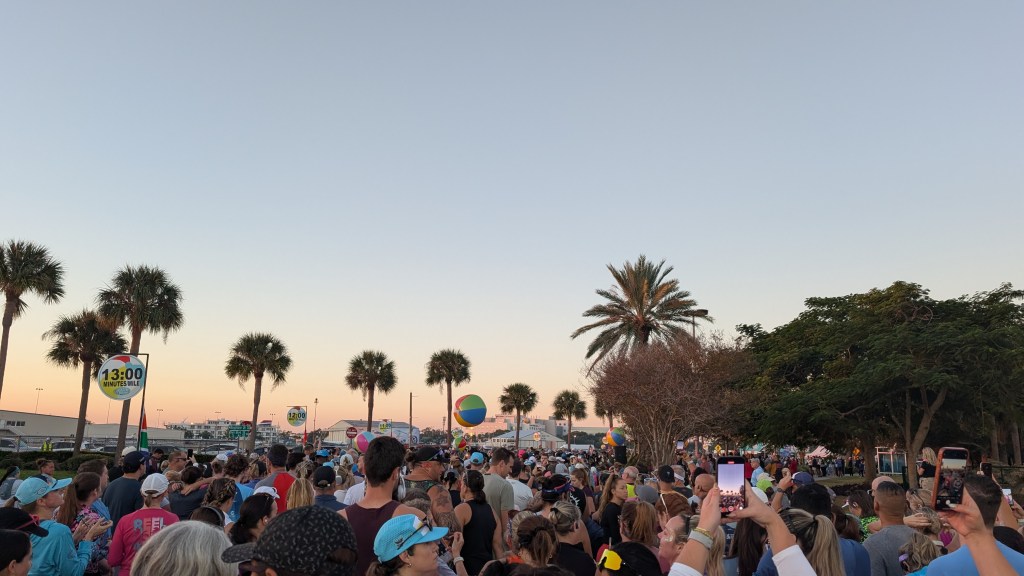
    The weekend after my CT was chaotic. My appointment with the surgeon and CT scan were on a Friday. My daughter and I had been training for the St. Pete RunFest 10k that was happening the next day, so I rushed back from Tampa, picked up the kids, and made it to packet pickup in time to get our race bibs. 

    It felt like I was floating between two worlds. Life went on, and I kept going through the motions, but my mind was completely consumed by what was happening in my body.

    My daughter and I got up the next day and ran the 10k. This was her first 10k, and I was so proud of her and happy that we had the opportunity to run together. The race was really fun, probably the best in terms of vibes and course entertainment that I’ve experienced outside of Disney races (although Gasparilla is great too).

    Since I had no idea what the timing of my surgery was going to be, I also decided to plan a last minute DIsney getaway for the same weekend. We have made a tradition of going over to resort hop and look at all the Christmas decorations. Normally we do this closer to Christmas but, not knowing if I would be having surgery by then, I wanted to squeeze it in earlier. So, after we cleaned up from the race, we headed to Disney.

    The Wilderness Lodge lobby is breathtaking!

    I told myself I would not check for my CT results until after we got back home, but my mind was spinning the entire trip with all of the what-ifs. I did my best to stay present and just take in the Disney magic. We stayed at Wilderness Lodge, which was definitely a splurge, but I absolutely love this hotel. Walking into the lobby is a breathtaking experience. I definitely have more of a value resort budget, so I don’t have any other deluxe resort stays to compare it to, but Wilderness is just so majestic that I think it’s my favorite. I had hoped we would be there for the Christmas decorations, but we were just a few weeks too early. We still got to see the parks all decked out for the holidays and eat way too many Mickey gingerbread cookies.

    I checked my Moffitt portal as soon as we were back home, and my CT results were there showing no signs of spread. I have never been so relieved. I had my MRI a week or so later. It showed the exact location of my tumor, which was high enough in my rectum and colon that surgery would be the first stage of treatment. The MRI showed a couple of “questionable” lymph nodes, but since I had the procedure with the local GI, we knew that this could have caused local inflammation and caused lymph nodes to show as enlarged even if the cancer had not spread. I still would not have the final staging until after my surgery, but all signs pointed to stage 1 or possibly stage 2 cancer.

    I’m going to end this post here, because it’s getting long and it seems fitting to stop somewhat in the middle of the story in a post called “waiting.” I’ll get to the rest of the story soon, I promise.

  • “We have a problem.”

    That’s the first thing I remember hearing my doctor say when I woke up after my colonoscopy. 

    I had been trying to explain away my symptoms for a while. My main symptom was blood in my poop (there’s no such thing as TMI once you’re dealing with colorectal cancer, so get used to the poop and butt stuff talk). It wasn’t constant or even very frequent, and I always came up with some kind of explanation for it – food that didn’t agree with me, drinking too much, or whatever else I could think of to make it not a big deal. I also had diarrhea off and on, but again, I always talked myself into some explanation for why it was fine. 

    Last year, however, it became clear that something was wrong because my symptoms were happening pretty much all the time. So I finally made the appointment with a gastroenterologist. I saw the doctor sometime in September, I explained what was going on, and we talked about a few things that could be causing my symptoms. IBS runs in my family so that was always what I suspected. I mentioned I was a runner and he even suggested that it could be runner’s colitis. He ordered some bloodwork, and a colonoscopy was scheduled for late October.

    I really did not want to get a colonoscopy. I had to do similar prep once before, years ago, for some kind of upper GI thing and I did not have fond memories of it. And mainly I didn’t want anyone looking at my butt or sticking something up it while I was asleep.

    But (haha) it really was not that bad. The prep is not fun; there’s really no way to sugar coat it. But in the scheme of things, it’s really not a big deal. Just plan to spend an evening in the bathroom. And get some diaper cream or Vaseline, it helps. 

    The procedure itself is easy peasy. They get you prepped, wheel you into the room, have you turn on your side, then it’s off to dreamland. That propofol nap really is the best nap you’ll ever have.

    The great thing about colonoscopies is that they can detect a precancerous polyp, remove it right there, and actually prevent cancer. I believe it is the only screening that actually prevents cancer. Don’t avoid it like I did! It could save your life.

    So, I woke up from my nice nap, and the doctor told me we have a problem. I was still pretty foggy at this point, but I remember him saying they found a tumor, he was sure it was malignant, but that it looked like it was stage 1 and he thought they could remove it during an endoscopic ultrasound procedure and I could avoid any further treatment. Spoiler alert: He was wrong. I did have the endoscopic ultrasound a couple of weeks later, they did remove part of the tumor, but overall it was unsuccessful. Based on what I know now, this should never have even been attempted. I’m still upset that I was put through the procedure, but what can you do?

    The Cancer Claw Machine

    When I was told I had cancer, I immediately felt like I had been separated from the rest of the world. The image in my mind was of a claw machine. Like one of the aliens in Toy Story, I was suddenly picked up and dropped into a different world. I remember waking up the next morning and immediately thinking “I have cancer.” The words just played on repeat in my head. But it still didn’t seem like they fit. Maybe there was a mistake. I’m healthy. How can I have cancer? I still sometimes can’t believe it.

    I left the colonoscopy in a haze, both from the medication and the diagnosis. What do you mean I have cancer? It didn’t seem real. I told my family and some close friends over the next few days, but generally I wasn’t ready to talk about it. At that point I knew so little, I didn’t even know what I would say if I did want to talk about it. But it was such an all-consuming thing to be dealing with, I felt like the rest of the world kept going but I came to a screeching halt the moment I was diagnosed. I was going through the motions of everyday life, because what else do you do, but my mind was spinning with all of the what-ifs and the things I needed to do.

    The crazy thing to wrap my mind around is that I probably have had cancer for the past 10+ years. Colon cancer grows relatively slowly, so most likely I have been carting around my little tumor for a decade or more. 

    I still don’t physically get out of the house very much, but slowly the mental isolation that I felt initially has softened. I have wonderful family and friends who have been very supportive throughout this whole ordeal. I’ve adapted somewhat to the never-ending medical appointments and procedures. Getting back into running has helped immensely. This is just life now.

    Learn to Endure

    I’m hoping to take the kids to Europe in the next couple of years, and I was researching Scotland because I would love to see some of the places where my ancestors lived. I went down a rabbit hole that brought me to a clan Duncan crest with the motto “Disce Pati,” which roughly translates to “Learn to Endure” or “Learn to Suffer.” Granted, this may not be the same clan Duncan from which I get my name (which is my mother’s surname), but I would like to think this is connected to my lineage somehow. I found this inspiring. I come from a family of fighters, and I can learn to endure this. 

    A few months ago, I read Man’s Search for Meaning by Viktor Frankl. Frankl was an Austrian psychologist who survived the horrors of a Nazi concentration camp. He talks about humans’ capacity for suffering, and about the importance of having meaning in one’s life. For me right now, my “why” is my kids. I have to be there for them and see them grow up, so I am going to do everything in my power to not only fight this, but to make the most of every day I’m given.
  • Starting in the Middle

    I’ve thought about writing since I was first diagnosed, almost 8 months ago. I’ve never been much for journaling, but there are so many thoughts constantly going through my head during this whole process that it seems healthy to get them down on paper. By sharing them, I hope that maybe I can help someone else who is on a similar journey. Or maybe a completely different journey. Who knows.

    I say this story is starting in the middle, but the reality is that I actually don’t even know if I’m in the middle yet. There are so many unknowns with cancer, and while right now my focus is getting through chemo, the possibility of recurrence is something I will be dealing with for the rest of my life. The only thing I know for sure is I’m somewhere past the beginning. I am 5 months post-op after colon resection surgery and a little more than halfway through a 6-month chemo regimen.

    I’ve never been spectacular at identifying my feelings. I remember when I started seeing a therapist more than a decade ago, and she actually had to give me a list of emotions to help me out. Cancer has brought up so many feelings. Fear, shock, sadness, optimism. That last one might sound strange, but in a way this whole process has been empowering. I feel like if I can endure this, I can endure anything (note to the universe: please don’t take that as a challenge). At any rate, I’ve decided to share my thoughts here because I think it will help me process this complete mind fuck of an experience, and maybe it will help someone else along the way. 

    I plan to write about my experience being diagnosed with cancer, going through treatment, and whatever else the future holds, cancer-wise. Anyone who knows me also knows that running has been a big part of my life for the past decade or so (with some breaks here and there). RunDisney in particular has been a huge source of joy and motivation in my life for the past couple of years, and it’s something I hope to get back to soon. While I took a bit of a break from running after I was diagnosed, I now have several races on the calendar so I’m starting to slowly get back into training. It feels good to have something to focus on other than cancer, even if running is physically harder than it has ever been. So this will also be a blog about running, to some degree. We shall see where my brain takes us. 

    On Monday morning I will head to Moffitt for infusion number eight. I have a total of twelve planned infusions. Each chemo cycle is two weeks. My infusions so far have been on Mondays. I show up, and the first step is labs so they can monitor how my body is handling chemo. They access my port (more about that later I guess, but it’s basically a little device implanted in my chest connected to a catheter that goes straight into my bloodstream near my heart). They take whatever blood they need, and the same port access is used to deliver my chemo. I see my doctor or PA before every other infusion, but I did that last time, so no provider visit this time. 

    Next, I go to the infusion center and wait to be called. My infusion takes about two and a half hours. First they give me pre-meds to ward off nausea and allergic reactions to the chemo, then it’s a 30 minute wait in a benadryl-induced stupor before the actual infusion starts. I’ll go into more detail on my actual chemo regimen in a later post, but I get one drug that takes ninety minutes, then a quick push of a second drug. 

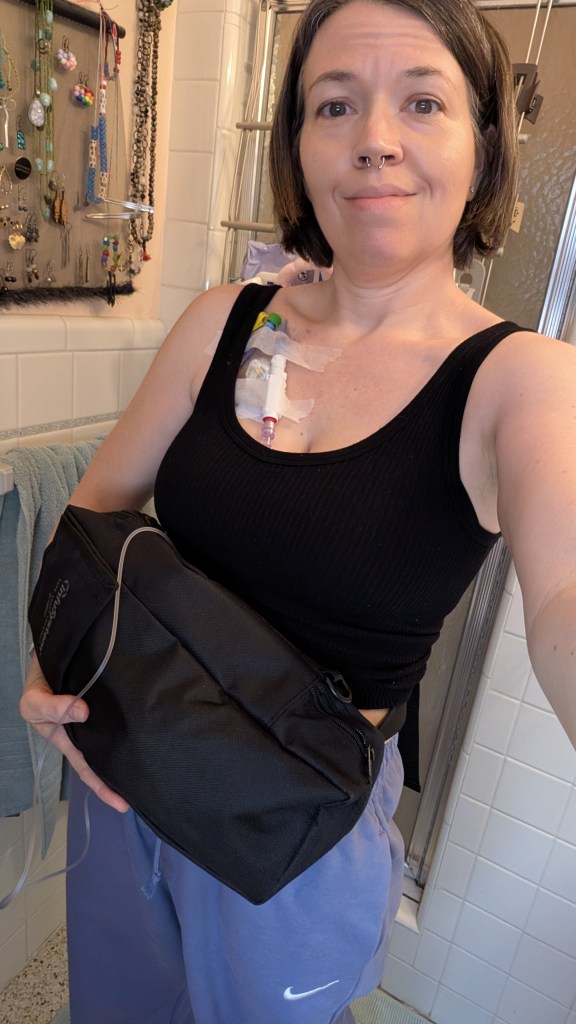
    The second drug also goes into a pump, which is connected to my port access and I then have to haul around for about 48 hours.

    This is not fun. When the pump was first described to me, I was told it was small and could fit under a loose t-shirt without being noticed. This is absolutely not true. It is large and heavy and a pain in the ass. Not to mention the constant worry about my cats chewing through the tubing and the absolute toxic chaos that would be unleashed. So far they’ve been good boys and have not bothered the poison tube.

    That’s a chemo infusion in a nutshell. I’ll report back on how it goes. The first few days after my infusion are rough. By Friday (four days post-infusion) I usually start to get back to something resembling normal.

    I haven’t written anything for others to read aside from memos for work (so many memos) in a very long time, so this will be an interesting exercise. Please let me know what you think! Are there any questions you have that you’d like me to answer?